How to Build a Hot Bed for Winter Growing
growing vegetables in winter,
Long before heated greenhouses, electric propagators and plug-in growing mats, gardeners had another way of keeping things moving through the colder months. They built hot beds.
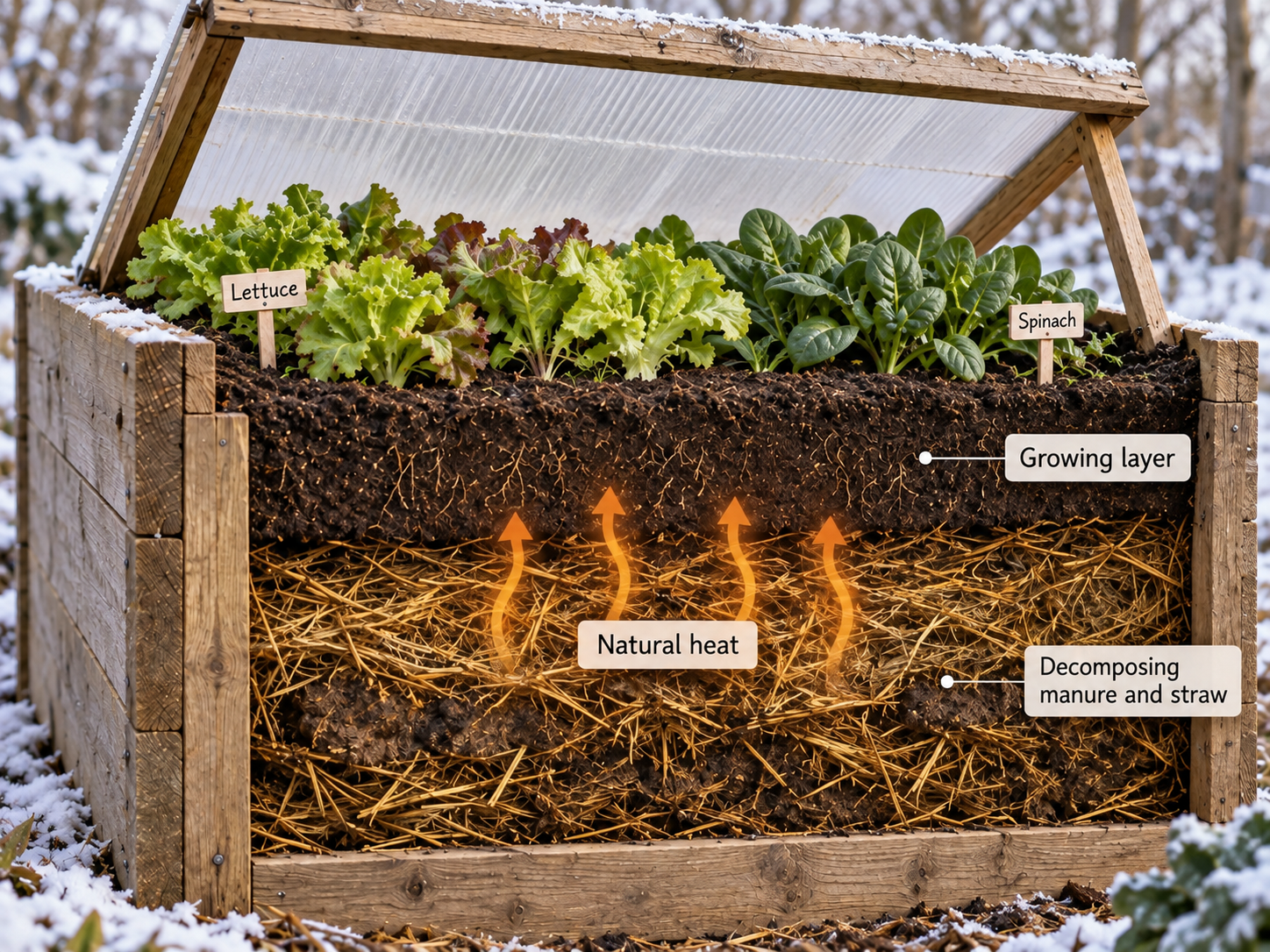
A hot bed is a wonderfully simple idea. Instead of using electricity to warm the soil, you use the heat produced as fresh manure and straw begin to break down. Put a growing layer on top, add some protection from the weather and you have a naturally heated growing space that can keep salad crops going through winter and give early spring sowings a useful head start.
It is an old gardening technique, but it still makes a lot of sense. If you can get hold of fresh stable manure, a hot bed turns something that might otherwise be seen as waste into heat, growing space and, later on, useful organic matter for the garden.
That is a fairly good return from one pile of manure.
What Exactly Is a Hot Bed?
The easiest way to think of a hot bed is as a cold frame with its own heating system underneath.
The lower section contains a generous depth of fresh, strawy manure. As microorganisms begin breaking it down, the material heats up in much the same way that a good compost heap does. Above that sits a layer of soil and compost in which the plants actually grow.
The whole thing is usually covered with a cold-frame lid, an old window, a sheet of clear polycarbonate or some other transparent cover. That helps hold on to some of the warmth while protecting the plants from cold winds, heavy rain and frost.
It is not going to turn the middle of January into July, and that is not really the point. What it does is create a little pocket of better conditions than the garden around it, and in winter that can make a surprising difference.
Why Gardeners Used Hot Beds
Victorian kitchen gardeners made plenty of use of hot beds because they allowed them to extend the growing season without modern heating. They used them for raising early seedlings, growing winter salads and starting crops before the outside soil was anywhere near ready.
On big estates they could be far more elaborate, but the basic idea was always the same: use the heat that decomposition is already producing instead of trying to create it from somewhere else.
That is still the attraction now. You are taking a natural process and putting it to work. When the heat eventually fades, the manure underneath has already started breaking down and can go on to be useful elsewhere in the garden.
Nothing very complicated is happening. That is part of the appeal.
The Best Material for a Hot Bed
Fresh strawy horse manure is the traditional choice, and the word fresh matters.
Well-rotted manure is excellent for improving soil, but it has already been through much of the decomposition that creates the heat you want. For a hot bed, you need material that still has some life in it.
Stable manure with plenty of straw bedding mixed through it works particularly well because you already have the manure and carbon-rich material combined. If it is very dry, it may need a little water as you build the bed. If it is soaking wet and compacted into a heavy mass, however, it may struggle to heat properly because decomposition also needs air.
You are looking for material that is moist and active rather than either dusty-dry or dripping wet.
Where to Put Your Hot Bed
Use the sunniest, most sheltered spot you can reasonably manage. A south-facing position is ideal, but it is not worth abandoning the whole idea because your garden does not happen to face the right way.
Shelter from cold winds can be just as useful as perfect orientation.
It is also worth thinking about convenience. Winter gardening is much less appealing if every trip to check the bed involves crossing half the garden through mud and rain. Put it somewhere you can actually get to without turning it into a chore.
You will need to open the cover from time to time as well, so leave yourself enough room to work around it properly.
How to Build a Simple Hot Bed
You do not need an elaborate permanent structure.
An existing cold frame is ideal, but a sturdy raised-bed frame with a transparent lid can work just as well. Reclaimed timber, old windows or leftover sheets of polycarbonate can all be perfectly usable if the structure is stable and lets in enough light.
Start with a substantial layer of fresh strawy manure. Traditionally, gardeners use something in the region of 60 to 90 cm. Add it in layers and firm each one lightly as you go. You do not want a loose heap full of enormous air pockets, but you also do not want to stamp it down so hard that no air can move through it at all.
Once the manure is in place, add around 20 to 30 cm of growing material on top. A mixture of decent topsoil and mature garden compost works well.
That upper layer matters because you are not trying to grow plants directly in fresh manure. The roots need a normal growing medium above it while the heat rises from underneath.
Put the transparent cover in place and then leave the bed alone for a little while.
This is the part people are most tempted to rush.
Do Not Plant It Straight Away
A newly built hot bed can become surprisingly hot. That is good because it tells you the decomposition is working, but it does not mean your lettuce seedlings will be delighted if you plant them the same afternoon.
The heat usually rises quite sharply at first, then begins to settle. What you want is the gentler, steadier warmth that comes after that first burst.
A soil or compost thermometer is useful because it takes some of the guesswork out of it, but it is not essential. If the bed is still steaming hard and has only just been built, give it more time. There is no advantage in being impatient here.
Once the growing layer has settled to a more sensible temperature, you can start using it.
What Can You Grow in a Winter Hot Bed?
This is where it helps to stay realistic.
A hot bed gives you warmth, but winter plants still have to cope with short days and low light levels. It will not magically make summer crops behave as though it is June.
What it can do very well is help crops that already tolerate cooler conditions. Winter lettuces, lamb’s lettuce, spinach, rocket, mustard leaves, mizuna, radishes and spring onions are all sensible choices. They are not being asked to do something completely unnatural; you are simply making their conditions a little easier.
Later in the season, the bed becomes useful in a different way. As the days lengthen, you can use it for early sowings and young plants that benefit from warmer roots. That is often when a hot bed starts to earn its keep properly because it bridges that awkward gap between deep winter and the point when the garden finally begins to warm on its own.
I would not try to force tender summer crops into it in December just because the soil feels warm. A tomato still needs light as well as heat, and a hot bed cannot provide that.
Keep an Eye on Sunny Days
It may sound odd to worry about overheating in winter, but a covered hot bed can warm up quickly when the sun comes out.
A transparent lid, warm soil underneath and a bright winter day can push the temperature higher than you expect, especially in a small frame. That is why ventilation matters.
On mild or sunny days, prop the lid open a little and let some air move through. Close it again when the temperature begins to drop.
You do not need to fuss over it constantly, but it is worth checking. A hot bed is not a box you seal in November and open again in March. It works best when you treat it as a small growing environment that needs a bit of attention.
Condensation will give you clues as well. Some moisture on the inside of the cover is normal, but if everything is constantly dripping wet and stale, the bed probably needs more ventilation.
Watering a Hot Bed
Because the plants are under cover, they do not get the benefit of normal rainfall. That means you still need to water, even in winter.
At the same time, crops are usually growing more slowly and using less water than they would in summer, so there is no point soaking the bed just because it feels like something you ought to do.
Push a finger into the growing layer and see what it actually feels like. If it is still damp, leave it alone. If it is beginning to dry out, water gently.
I would rather underdo it slightly and check again than keep the whole bed permanently wet through the coldest part of the year.
How Long Will the Heat Last?
The strongest heat does not last forever, and it is not supposed to.
The bed will warm up, hold useful heat for a while and then gradually cool as the manure breaks down. By that point, though, the days are usually getting longer and outside conditions are beginning to improve.
That is one of the clever things about the system. The bed gives you extra help when winter is doing its worst, then slowly hands the job back to the sun as spring comes in.
By the time the heat has largely gone, the manure underneath has already started turning into something far more useful and manageable. It can eventually be spread elsewhere in the garden once it has broken down properly.
So even when the heating part is finished, the material itself has not been wasted.
Can You Make a Small Hot Bed?
Yes, although a very small bed will not hold its heat as well as a larger one.
You need enough organic material for decomposition to build and retain warmth. That does not mean you need to recreate a Victorian walled garden, but there is a point at which a tiny box of manure stops behaving like a useful heat source and simply cools too quickly.
For an ordinary garden, a cold-frame-sized hot bed is a sensible compromise. It gives you enough material to generate heat without taking over half the garden.
If you only want a little winter salad or somewhere to raise early seedlings, that may be all you need.
What If You Cannot Get Fresh Horse Manure?
This is probably the biggest difficulty for many modern gardeners.
If you live near stables, riding schools or smallholdings, it is worth asking locally. Fresh stable manure is sometimes cheap or free simply because people need somewhere for it to go.
It is worth asking what bedding has been used and, if possible, whether the hay or grazing land has been treated with persistent herbicides. Some herbicide residues can survive the trip through an animal and into the manure, and they can cause real problems for sensitive garden plants later.
If you are unsure, be cautious.
I would also avoid buying bags of well-rotted manure from a garden centre expecting the same result. It may be excellent for the soil, but it has already lost much of the heat-producing activity that makes a hot bed work.
An Old Idea That Still Earns Its Place
I like old gardening methods when they still solve a real problem.
There is no point doing something the awkward way simply because gardeners did it two hundred years ago. Plenty of modern gardening tools and techniques are better because they genuinely make life easier.
A hot bed is different because the basic idea is still sound.
Organic material is going to break down. That process is going to produce heat. Instead of letting all of that warmth disappear into the air, you use some of it to help plants through the coldest part of the year.
There is no electricity involved and no expensive piece of equipment to buy. What you need is fresh manure, a growing layer, some sort of cover and a little bit of attention.
For anyone who likes the idea of extending the season without turning the greenhouse into another household heating bill, a hot bed is one of those old techniques that is genuinely worth remembering.